
Hochbeet mit Sichtschutz aus Holz und Edelstahl auf Terrasse, modernes Gartenmöbel
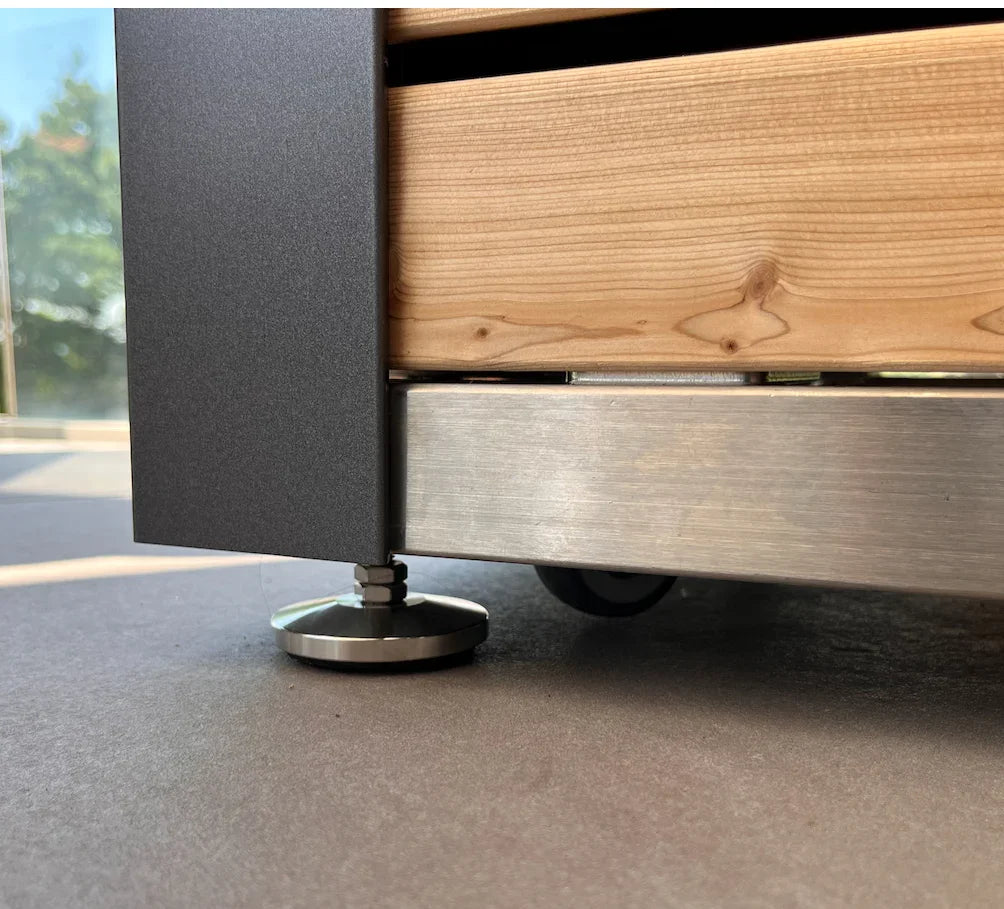
Detailansicht eines Hochbeets aus Metall und Holz mit höhenverstellbarem Stellfuß
Hochbeet mit Sichtschutz aus Holz und Metall, bepflanzt, modernes Design, RAL7016
Technische Zeichnung Hochbeet mit Sichtschutz aus Metall, Maße und Seitenansicht dargestellt
Hochbeet mit Sichtschutz aus Holz und Metall, bepflanzt, auf weißem Hintergrund.
Hochbeet mit Sichtschutz aus Metall und Holz, modern und robust, freigestellt
Hochbeet mit Sichtschutz aus Holz und Metall, moderne Gartenlösung auf Rollen

Raised garden bed with privacy screen, wood, metal, stainless steel, with Siberian larch, 40 x 150 x 170 cm

SKU: 150002-OHNE-MITROLLENUNDSTELLFÜßE-BESCHICHTETINRAL7016

High-quality 1.4301 stainless steel for maximum durability

Elegant larch wood filling for a natural look

Integrated water tray with drain to prevent waterlogging

Can also be used as a privacy screen with a climbing aid

Delivered fully assembled including shipping costs

Bubble wrap:

Bubble wrap

Casters and leveling feet:

Casters and leveling feet

Corner cover:

Corner cover

Quantity:
Sale price1.844,50 €inkl. MwSt.

Kostenfreier Versand Versandinfos

Lieferzeit: 21 to 28 days
Spedition/Paketdienst mit Terminankündigung (Avis)
Frage zum Produkt
American Express Apple Pay EPS Google Pay Klarna Mastercard PayPal Visa Kauf auf Rechnung Vorkasse
5,0 82 Google-Bewertungen

Raised Bed with Stainless Steel & Larch Wood Privacy Screen – 150 × 40 cm

This raised bed, made from rust-free 1.4301 stainless steel and Siberian larch, combines a planter and a privacy screen in one piece of furniture. The high back wall serves as both a privacy screen and a climbing aid for your plants. A circumferential stainless steel base frame keeps the lowest wooden row off the ground, and the concealed screws ensure a clean, modern look. Made in Germany – direct from the manufacturer.

Design & Technical Details

  • Base frame and all connections made from rust-free 1.4301 stainless steel (V2A)
  • Wood filling made from high-quality Siberian larch
  • Top cover entirely made of stainless steel – protects the wood from weathering
  • Wooden bottom with metal tray and integrated drain – prevents waterlogging
  • High back wall as privacy screen and climbing aid
  • Concealed screw connections for a flush appearance
  • Dimensions (L × W × H): 150 × 40 × 165 cm (with castors 170 cm)

Options & Accessories

  • Optional castors and adjustable feet – easily movable on a balcony or terrace even when filled; adjustable feet secure the stand without rolling away
  • Optional raised bed dimpled sheet without plasticizers
  • Corner covers and angle brackets optionally in stainless steel or powder-coated in RAL 7016

Delivery

The raised bed is delivered fully assembled – simply unpack and position it on site. The price includes shipping and delivery.

Questions and Answers

Due to the elevated position, the substrate warms up faster, which extends the growing season. In addition, the plants are better protected from weed seeds drifting in near the ground, and gardening becomes much more ergonomic.

Direct ground contact and waterlogging quickly lead to rot in wood. Our system uses a sturdy stainless steel support frame as a protective barrier, so the wooden cladding does not absorb any ground moisture, which multiplies its service life.

Larch is one of the hardest softwoods and, thanks to its high resin content, naturally extremely weather-resistant. Left untreated, it develops an elegant, silver-gray patina over time that underlines its natural character.

Yes, working at an elevated position relieves the back and joints. With appropriate planning for wheelchair clearance underneath, our raised beds can be designed barrier-free for wheelchair users, enabling precise care at eye level.

A fine-mesh wire grid at the bottom of the raised bed serves as reliable rodent protection. It effectively prevents voles from entering the bed from below and damaging the roots.

The bed is built up systematically: after the rodent guard comes a drainage layer of coarse branches, a filling layer of garden waste such as leaves and grass clippings, and finally the top planting layer of at least 30 cm of high-quality humus.

No, a raised bed should not be dug over, so as not to disturb the established microfauna and layering. It is completely sufficient to top up spent substrate with fresh soil at the surface each year.

After about five to seven years, the decomposition process of the lower layers is complete and the raised bed should be set up anew. The outer stainless steel construction remains dimensionally stable over many such cycles.

Yes, optional corner covers allow concealed mounting of the connecting elements. This creates a modern, flush aesthetic entirely without visible screw connections on the visible sides.

Corten steel is weathering structural steel (material no. 1.8965 or 1.8946) alloyed with copper and chromium. This makes it behave differently from untreated structural steel St37 or S235: instead of porous, flaking rust, a firmly adhering protective patina forms that shields the steel underneath from further corrosion.

A raised bed made of genuine Corten steel therefore does not rust through, but lasts for decades – without paint, without coating and practically maintenance-free. When comparing products, check whether real Corten steel has actually been used and not plain structural steel with a rust look.

The raised bed is delivered in steel grey or already partly rusted. Outdoors, the characteristic rust patina develops gradually through rain and sun – it is fully formed after around 1.5 to 3 years.

If you want the warm rust look sooner, you can speed it up with a standard rusting accelerator: the surface must be dry and free of grease and dust, then the product is applied evenly to all visible surfaces. The first rust appears after a few hours; for an even color, the application is repeated after 24 hours.

You combine length, width and height freely, each in 10 cm increments: length 40 to 240 cm, width 40 to 120 cm and height 40 to 110 cm. The width cannot be greater than the length.

This results in over 1,200 size combinations with a planting volume of around 64 to 3,168 liters – from a narrow bed for the balcony to a large cultivation bed. You can see the price of your combination directly in the configurator.

You do not have to select the material thickness yourself. We derive it from the length of your bed, because the soil pressure on the side walls increases with the length: lengths of 40 to 70 cm get 2 mm, 80 to 140 cm get 3 mm, 150 to 190 cm get 4 mm and 200 to 240 cm get 5 mm.

The matching sheet thickness is already included in the price of the respective size combination – there is no surcharge.

No. The raised bed arrives as a single component welded at all four corners – no kit, no tools, no bolted edges and no visible joints. Unpack, align, fill.

Three details keep it dimensionally stable when fully filled: a double-folded top edge turned inwards, a folded bottom edge of 30 mm for a secure stand, and a horizontal stiffening profile on the inside that prevents the side walls from bulging. Delivery is by freight forwarder.

All Corten steel raised beds are made without a base as standard and therefore sit in open contact with the ground. On lawn and garden soil this is ideal: rainwater drains away, and soil life and earthworms move in from below.

The bed can also be set up on solid surfaces such as a patio or balcony, as long as excess water can drain off. To protect against voles, additionally lay a fine-mesh wire grid on the ground before you fill it.

For locations with slug pressure, the same raised bed is available with a top edge folded outwards. The overhanging rim acts as a mechanical barrier and makes the way over the bed wall considerably harder – entirely without chemicals.

Construction, size ranges and sheet thicknesses are identical to the standard model in this version; the only difference is the direction of the fold at the top edge.

Yes. For this there is the set of 4 Corten steel corner posts: the four posts form the basic frame into which you screw standard wooden boards from the DIY store. This lets you determine the length and height of your bed freely.

Each post measures 94 × 94 × 720 mm with a material thickness of 2 mm and has 24 pre-drilled holes for wood screws. The set is designed for a board thickness of 20 mm and is simply set in place – no ground fixing is required. Wooden boards and screws are not included in delivery.

The configurator covers rectangular beds in over 1,200 size combinations. If you need an intermediate size outside the 10 cm grid or a different shape – L-shaped for a corner, for example, or as a continuous bed along a patio – we produce it as a custom-made item.

Just send us a sketch with your dimensions. You can reach us by phone at 09672 9269 110, Monday to Friday from 8 a.m. to 4 p.m.

During the first few months, yes. While the patina is forming, rainwater washes fine rust particles off the surface. On light-colored garden slabs, paving or a wooden deck this can leave brownish streaks. As the patina consolidates, the effect diminishes noticeably, but over the years it will not stop entirely.

Factor this into your choice of location: on a lawn, bark mulch or gravel it is not noticeable at all. If the raised bed is to stand on a light-colored, paved surface, lay a narrow strip of grit or gravel around it or place it on a base. That catches the run-off marks before they reach the surface. Prevention is considerably easier here than removing stains that have soaked into absorbent natural stone.

It is not strictly necessary. The raised bed is manufactured without a base, excess water drains away downwards, and the patina protects the steel on its own.

Many gardeners still line the inner wall with a dimpled membrane, for two reasons: the membrane keeps permanently damp soil away from the inside face, and it buffers the heating of the steel wall, which rises noticeably on the sunny side in midsummer. That is gentler on the roots sitting directly against the bed wall.

If you do line it, use a dimpled membrane without plasticizers and leave the bottom open so that water can still drain away and earthworms can move in from below.

Yes. The noble rust patina is a firmly adhering protective layer and releases no harmful substances into the soil. The traces of iron that pass into the soil act more like a mild natural iron fertilizer.

Corten steel raised beds are suitable for herbs, salad greens and vegetables without restriction.