

Whether it's a balcony, staircase, terrace, or floor-to-ceiling window: as soon as there is a risk of falling, building regulations require a fall protection system – and in most cases, this is a railing. At the same time, a railing shapes the appearance of a facade and interior like hardly any other structural element. This guide summarizes which regulations apply, what railing height is mandatory, which material is suitable for which purpose, and what a custom-made railing costs.
When is a railing mandatory?
The state building codes of the federal states generally require a barrier from a fall height of approximately 1 m – i.e., on balconies, galleries, stairs, platforms, cellar entrances, and floor-to-ceiling windows on upper floors. For floor-to-ceiling windows, a French balcony is the most common solution: it is mounted directly on the facade and secures the opening without obstructing the view.
Railing height: 90 or 110 cm?
The required height depends on the fall height. As a rule of thumb across almost all federal states:
- Up to 12 m fall height: Railing height at least 90 cm
- Over 12 m fall height: Railing height at least 110 cm
- Stair railings: Dimensions according to DIN 18065, usual handrail height is 90–100 cm
- Industrial railings at workplaces: DIN EN ISO 14122-3 with knee and possibly toe board
Individual federal states may differ in detail – binding information can be obtained from the respective state building code or the local building authority.
Infill and bar spacing: Child safety first
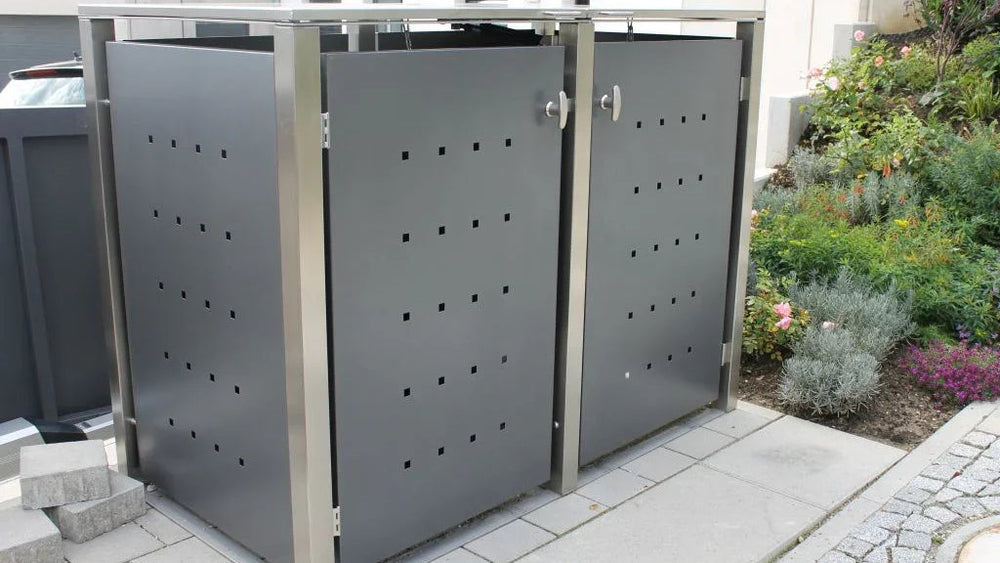
In addition to height, the infill is crucial. The clear distance between vertical infill bars may not exceed 12 cm to prevent children from slipping through. Horizontal struts are impermissible or critical in many federal states because they act like a ladder (ladder effect). Safe and at the same time aesthetically attractive alternatives are vertical solid material bars, glass infills, or perforated sheets.
Which material for which railing?
Hot-dip galvanized steel
The zinc layer reliably and maintenance-free protects the steel from corrosion – the economical choice for outdoor use. Our article Hot-dip galvanized vs. electro-galvanized explains why hot-dip galvanizing is superior to electro-galvanizing.
Hot-dip galvanized + powder coating (Duplex)
If you want color, combine hot-dip galvanizing with a color powder coating in your desired RAL color, e.g., RAL 7016 Anthracite. The duplex system offers double corrosion protection and matches the color of windows and facade.
Stainless steel V2A / V4A
Rust-free, elegant, durable – stainless steel is the premium solution for timeless architecture. In coastal areas or with chlorine exposure, V4A is recommended instead of V2A. You can read what to look for in quality in the article Stainless steel V2A & V4A – Differences and Quality.
Recognizing quality: Welds and DIN EN 1090
A railing is a safety-relevant component. Therefore, pay attention to a specialized company with DIN EN 1090 certification, solid infill bars made of solid material instead of thin-walled tubing, and cleanly executed, ground welds. We show what good welding work looks like in the article Weld quality at Kirchberger Metall.
What does a custom-made railing cost?
Custom manufacturing from German production is more affordable than many expect. Some reference values from our shop (as of 07/2026):
- Balcony railing model Bavaria, hot-dip galvanized: from €199
- French balcony, galvanized: from €245
- Railing model Lines, hot-dip galvanized + powder coated: from €284.85
- Glass railing model Vista: from €396.50
- Stainless steel railing set Domus E/S (Module 150 × 110 cm): from €472
The online configurator immediately displays the exact price for your desired dimensions – without inquiry and waiting time.
Install yourself or have it installed?
All railings are pre-fabricated to the millimeter and delivered ready for installation. Handymen can install them themselves with our instructions; alternatively, we take over the installation ourselves depending on the region or through regional installation partners. In both cases, professional fastening with officially approved anchors that safely transfer the loads into the supporting component is important.
Conclusion: Safety according to standard, optics as desired
A good railing meets the requirements of the state building code (90/110 cm height, max. 12 cm bar spacing), consists of weather-resistant material, and comes from a certified specialist company. All models – from the balcony railing to the stair railing to the French balcony – can be found in our overview Custom-made railings: configure online, see the price immediately, order securely.