

Stainless Steel as a Material – What Should You Know and How Can You Recognize Quality?
Not all stainless steel is the same. For railings, canopies, balconies, porches and other outdoor structures in particular, choosing the right grade of stainless steel determines service life, safety and value retention.
Unfortunately, lower-quality grades are increasingly being used in the market. They may look similar, but they corrode more quickly in practice.
Our quality promise at Kirchberger Metall:
We use exclusively certified V2A and V4A stainless steels – with material certificates. No mixed grades, no cheap alloys, full traceability.
V2A – proven stainless steel for indoor and outdoor use
Composition: 16–18% chromium, 8–10% nickel
V2A (e.g. material number 1.4301) is the best-known stainless steel in metal construction. It offers good corrosion resistance and is very easy to work with.
- Good corrosion resistance under normal conditions
- Very easy to weld and form
V4A – stainless steel for demanding environments (coastal areas, industry, swimming pools)
Composition: 16–18% chromium, 10–13% nickel + 2–2.5% molybdenum
V4A (e.g. 1.4404) also contains molybdenum. This makes it significantly more resistant to chlorides, moisture, seawater and road salt.
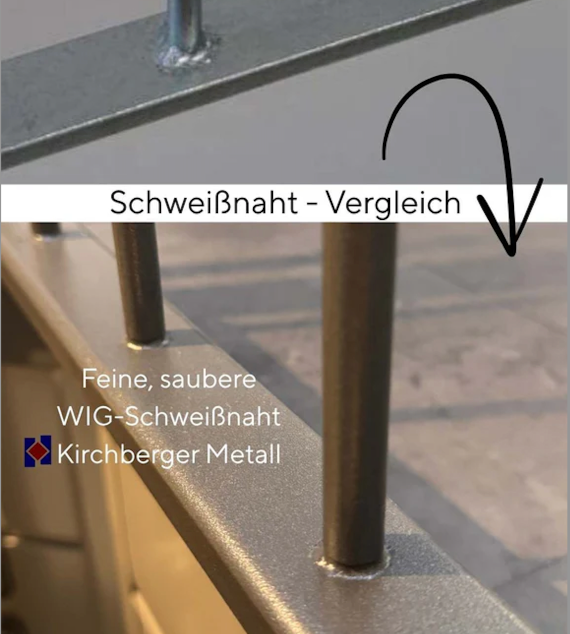
The right surface treatment (K320 finish at Kirchberger Metall) further enhances the surface and protects it against corrosion.
The problem with the market: The term “stainless steel” is no proof of quality
Many inexpensive railings and kits are sold as “stainless steel” without clearly specifying the grade or providing proof. Often, the material number, material inspection certificate and traceable origin are missing. This can lead to rust, corrosion at weld seams or unsightly brown streaks.
Low-quality stainless steels imported from the Far East
(Common in cheap railings, marketplace listings and no-name kits.)
201 / 202 stainless steel (common problem grades)
These grades are often characterized by significantly reduced nickel content, replaced by other elements (e.g. manganese and nitrogen). They often look similar to V2A but are significantly less corrosion-resistant in practice – especially outdoors.
- Prone to corrosion after just a few months outdoors
- Looks like V2A – significantly inferior in performance
- Often unsuitable/non-compliant with standards for construction products in Europe
Typical problems:
- brown rust stains
- pitting corrosion
- rust at weld seams
- “rusts despite being stainless steel”
“304 look-alike” / fake V2A
Materials are sometimes sold as “304” or “V2A” without clear proof of the material grade or traceable certification (e.g. to EN 10088). A material certificate in accordance with EN 10204 (3.1) is often missing. The risk: inconsistent quality, mixed melts and a high risk of liability claims and complaints.
- No clear proof of the material grade
- No traceable certification
- Often supplied without a 3.1 material certificate
- Inconsistent quality and a higher risk of complaints
Conclusion: Quality you can not only see, but verify
If you value honest material specifications, certified stainless steels and verifiable quality, Kirchberger Metall is the right choice.
Certified V2A and V4A stainless steel – with material certificates. No compromises.
Discover our quality stainless steel products, including French balconies and window grilles, as well as canopy kits.